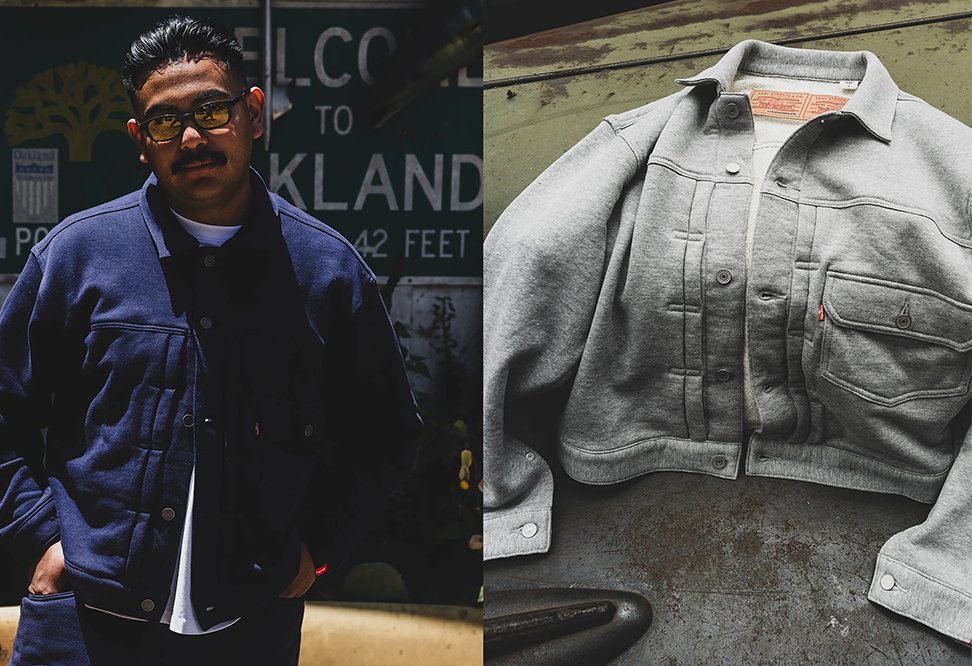
The collaboration replaces conventional woven denim with ultra-slow Japanese Tsuriami knit, showing how fabric construction itself can become the basis for premium product differentiation.
Levi’s, BEAMS and Japanese knitwear specialist LOOPWHEELER will launch a six-piece capsule on October 17, translating Levi’s established Super Wide denim silhouettes into rare Japanese loopwheel-knitted fabric. The collaboration marks BEAMS’ 50th anniversary and the fifth Levi’s–BEAMS project, with LOOPWHEELER participating for the first time.
The range comprises the Super Wide Type I Jacket and Super Wide Pant in heather grey and navy, plus red and navy bandanas. Japanese retail prices are ¥58,300 for the jacket, ¥49,500 for the trousers and ¥4,400 for the bandana. The collection launches initially at selected BEAMS stores in Japan, followed by Levi’s global channels on October 22 and BEAMS America on October 23.
Production speed becomes the luxury feature
The key material is LOOPWHEELER’s Tsuriami fabric, made in Wakayama on historic circular knitting machines operating at around 24 revolutions per minute. LOOPWHEELER says the low-tension process places minimal stress on the yarn, producing a soft yet durable fabric.
Production is exceptionally slow. The company explains that a Tsuriamiki machine can make only around one metre of fabric per hour, depending on construction, because each rotation forms only one course and the machines have very few yarn feeders.
Fabric innovation beyond new fibres
The commercial lesson is that textile differentiation does not always require a new fibre or chemical finish. Here, machine architecture, production speed, yarn tension, fabric handle and scarcity become part of the product proposition.
For denim and knitwear manufacturers, the concept points toward hybrid categories combining the visual language of denim with knitted comfort, drape and softness.
Competitiveness takeaway
Exporter’s opportunity is not to copy century-old Japanese machinery, but to apply the same principle: make fabric construction itself proprietary and marketable.
Denim and knitwear mills could experiment with indigo-look knits, engineered fleece, knitted workwear structures, special yarn combinations and distinctive surface effects. As basic denim becomes increasingly commoditised, competitive advantage can come from selling a recognisable textile experience—not simply another fabric specification.