

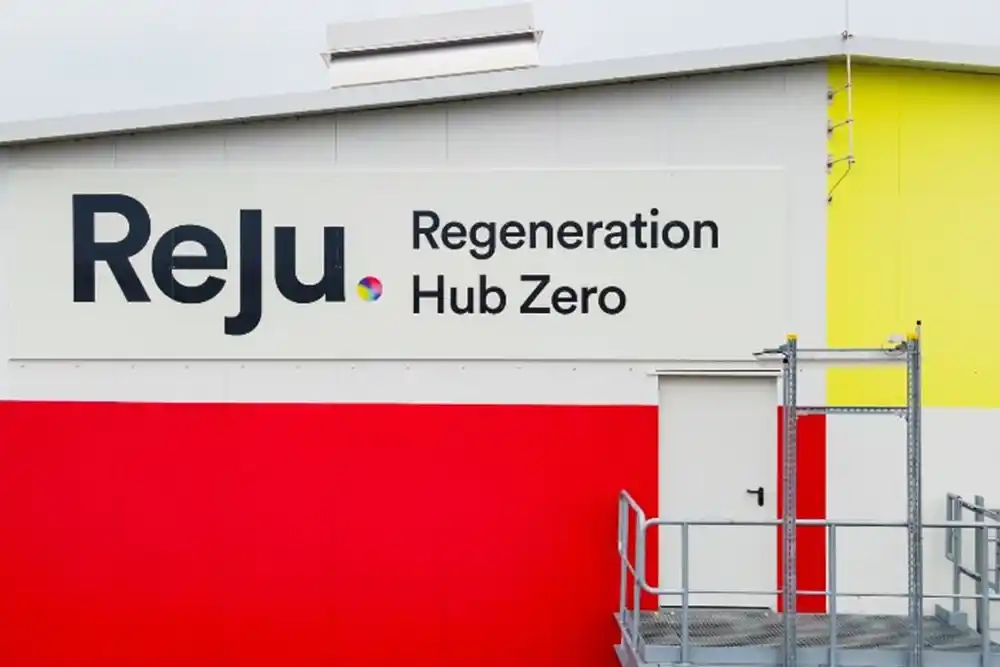
French textile-to-textile recycler Reju has announced plans to establish its first industrial regeneration hub in the United States, selecting Rochester, New York, as the proposed site. The facility would be located on 18.9 acres at Eastman Business Park, marking a significant step in scaling Reju’s circular textile ambitions globally.
The project remains subject to final investment approval by the board of Technip Energies, Reju’s parent company.
Scale and technology
If approved, the Rochester hub aims to regenerate the equivalent of 300 million textile articles. Post-consumer textile waste will be chemically converted into rBHET, which is then repolymerised into Reju PET, a recycled polyester engineered for multiple recycling cycles.
Reju’s proprietary recycling technology was developed in collaboration with IBM Research and delivers material with a 50% lower carbon footprint than virgin polyester, positioning it as a high-impact solution for apparel and textile circularity.
Strategic expansion
According to Patrik Frisk, the U.S. site represents a pivotal milestone: “As our first regeneration hub in the United States, this site selection is a major leap forward in building a truly global circular system. We are proud to bring Reju’s sustainable manufacturing and jobs to the Rochester community.”
The proposed facility is expected to create around 70 new jobs, strengthening Reju’s North American footprint.
Global circular roadmap
Reju already operates a demonstration plant in Frankfurt, Germany, and has previously announced another regeneration hub in Sittard, Netherlands. The Rochester project would complete a tri-continental platform designed to bring textile-to-textile recycling closer to major consumption markets.
Frisk added that the investment signals growing confidence in circular textiles at scale, reframing post-consumer textile waste as a strategic raw material rather than a liability.
Bottom line:
If approved, Reju’s Rochester regeneration hub would be a landmark for U.S. textile circularity—linking large-scale chemical recycling, job creation, and low-carbon polyester production into a globally integrated system.

