

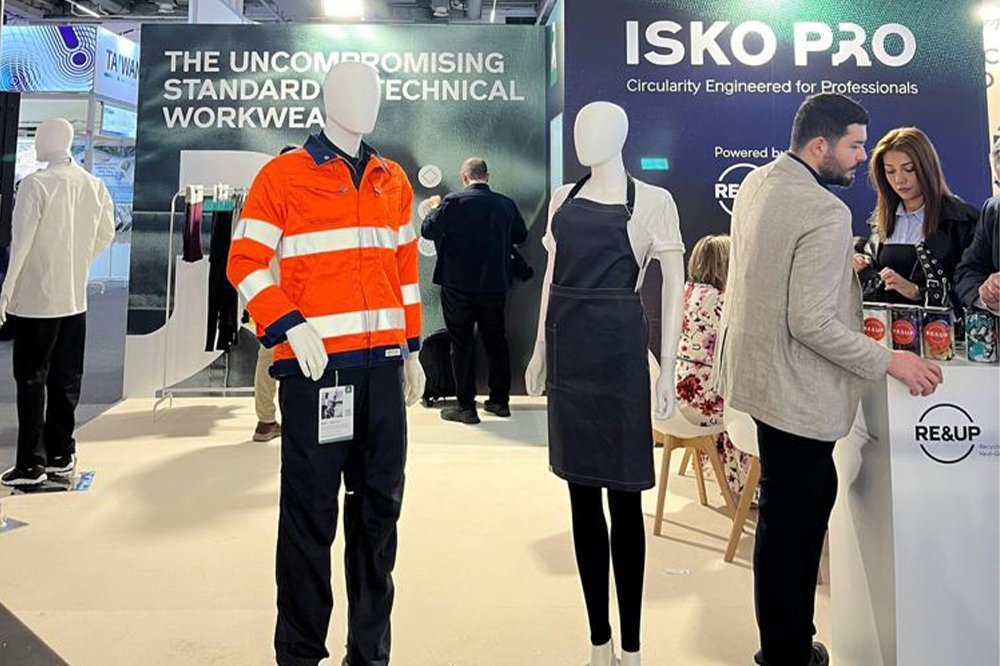
The Frankfurt showcase matters because it tests circular fibres in one of the industry’s toughest end uses: high-performance workwear.
RE&UP is using Techtextil 2026 to make a practical case for textile-to-textile recycling in workwear, presenting its Next-Gen Cotton and Next-Gen Polyester at the ISKO Pro booth in Hall 9, Booth D31. The company says the fibres are engineered to meet the durability, consistency and processing demands of professional wear, a category where recycled materials have often struggled to match virgin-fibre performance. Techtextil 2026 is being held in Frankfurt from April 21 to 24.
A harder test for recycled fibres
The significance of the demonstration lies in the application. Workwear is far less forgiving than fashion basics: fabrics must withstand abrasion, repeated laundering, mechanical stress and high-speed industrial processing. RE&UP says its specialised decolorisation process allows recycled cotton and polyester inputs to be integrated into existing spinning and weaving lines without disrupting efficiency or finished-fabric quality. That positions the ISKO Pro collaboration as more than a trade-fair concept; it is being framed as a manufacturing proof point for technical textiles.
From pilot story to sourcing proposition
RE&UP is also leaning on a broader set of market signals to support its claim that its platform is commercial rather than experimental. The company’s announcement points to existing collaborations with brands including Puma, ONLY and Madewell. Puma separately announced a multi-year collaboration with RE&UP in March 2025 as part of its fibre-to-fibre recycling push, including support for its RE:FIBRE programme and a target to use 30% fibre-to-fibre recycled polyester fabric in apparel by 2030. RE&UP and partners have also highlighted Madewell-linked circular denim work this month.
Why mills and buyers will watch
For mills, spinners and workwear buyers, the real question is not whether circular fibres can be produced, but whether they can run reliably at industrial scale. Marco Lucietti, RE&UP’s head of global marketing and communications, said the Techtextil presentation is intended to show that circularity “at scale is production-ready” and capable of performing in “the toughest mechanical and industrial environments.” The next test is whether such demonstrations translate into repeat sourcing programmes, larger volumes and long-term adoption in technical textiles, where performance failures carry immediate commercial costs.
