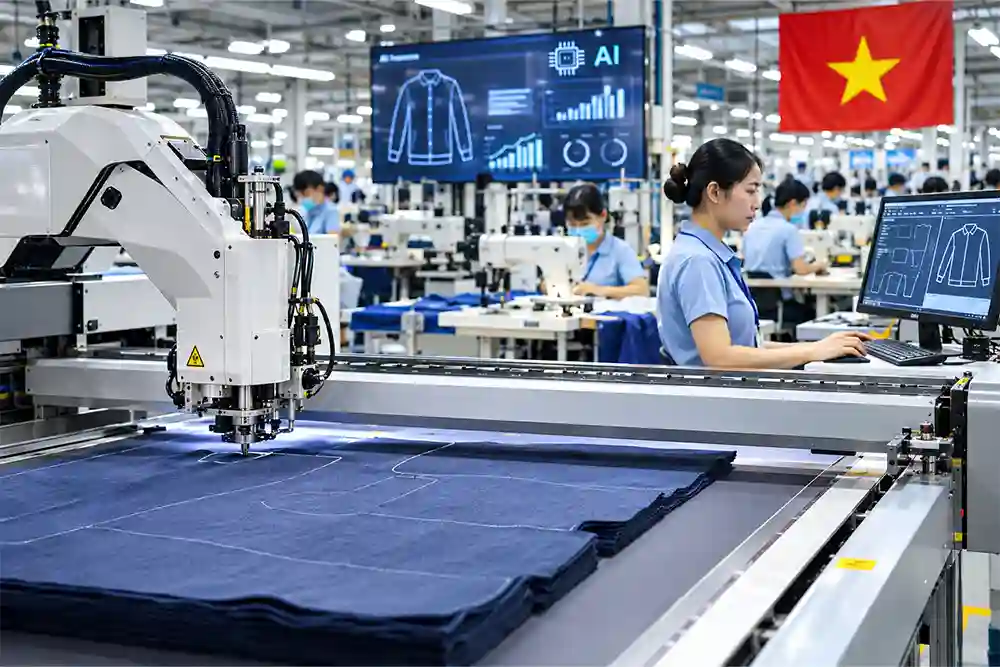
Vietnam is shifting from labour-intensive garment manufacturing towards AI-driven production, automation and digital supply chains to improve productivity, reduce costs and meet increasingly demanding international buyer requirements.
Vietnam’s textile and garment industry is accelerating the adoption of artificial intelligence, robotics and industrial automation as manufacturers seek to strengthen competitiveness and move into higher-value production.
The strategy was highlighted at the 12th International Conference on Textile Technology, held in Hanoi on October 29, 2026, organised by the Vietnam Textile and Apparel Association (VITAS), Korea Institute of Industrial Technology (KITECH) and Vietnam’s Industrial Development Support Center.
From Low-Cost Labour to Intelligent Manufacturing
Đỗ Nam Bình, deputy director of the Ministry of Industry and Trade’s Industry Agency, warned that Vietnam’s traditional reliance on inexpensive labour was becoming increasingly unsustainable.
He identified AI applications across product design, demand forecasting, production scheduling, material optimisation, quality inspection and supply-chain management.
Robotics could improve fabric spreading, cutting, material handling, inspection and packaging.
However, the complexity of handling flexible fabrics and frequently changing garment designs makes automation more challenging than in conventional manufacturing.
Productivity Gains Require Targeted Investment
With more than 70% of textile and garment businesses classified as SMEs, large-scale automation remains financially challenging.
Industry officials recommend beginning with targeted pilot projects, evaluating their performance and gradually expanding successful technologies.
Investment effectiveness should be measured through labour productivity, fabric utilisation, defect rates, production lead times and operating costs rather than machinery installations alone.
Exports Reach $35.72 Billion
Vietnam’s textile and garment exports reached $35.72 billion during January–September 2026, increasing 3.3% year on year.
The industry exported $46.2 billion in 2025, generating a trade surplus of approximately $21 billion and supplying 138 international markets.
Domestic value addition reached around 52%, reflecting growing local material and accessory manufacturing capabilities.
Vietnam is targeting approximately $49 billion in exports during 2026.
Digital Transformation Extends to Compliance
VITAS Vice Chairman Trương Văn Cẩm emphasised that digitalisation must also support traceability, lower emissions and verifiable sustainable sourcing.
For machinery suppliers and textile manufacturers, opportunities extend beyond automation to integrated production data, quality management and supply-chain platforms.
The next test is converting AI and robotics investments into verified productivity improvements, competitive manufacturing costs and stronger export performance.