

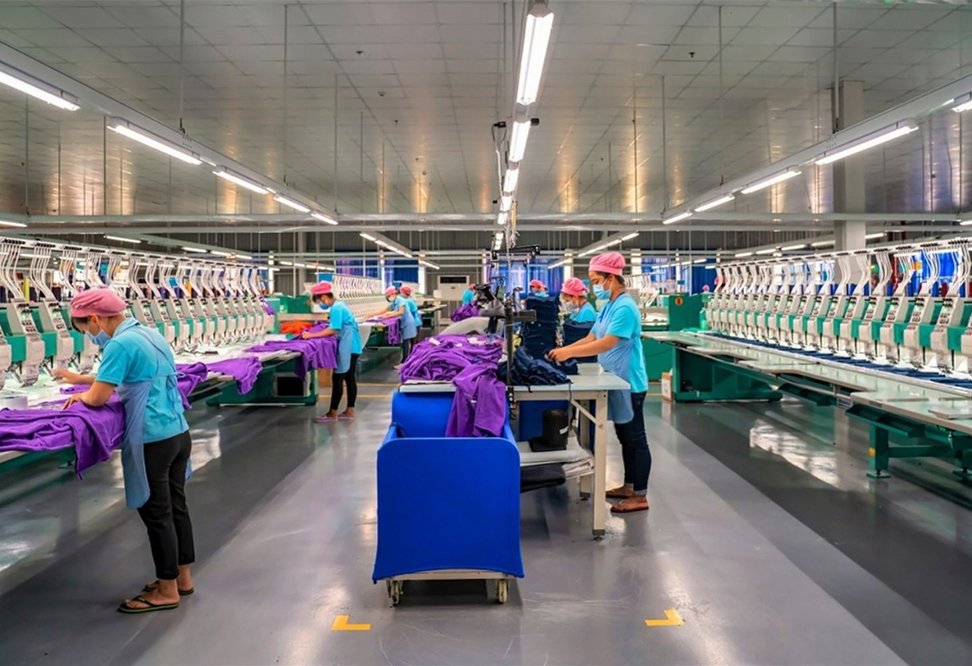
Garments remain the export engine, but Vietnam’s 2026 target will require stronger orders, market diversification and faster investment in digital and green production.
Vietnam’s textile and garment exports reached an estimated $10.57 billion in the first quarter of 2026, up 2.9% year on year, according to the Vietnam Textile and Apparel Association. The modest quarterly gain was lifted by a strong March recovery, when export turnover rose to $3.86 billion, up 36% from February and 5.8% from March 2025.
Garments still dominate
Apparel remained the core export category, generating $8.18 billion in the first quarter, a 2.2% increase. Other textile segments also expanded: fibre exports reached $1.09 billion, up 5%; fabric exports totalled $719 million, up 3.9%; and nonwoven fabrics brought in $199 million, up 4.2%. Accessories posted the strongest growth among reported categories, rising 11.8% to $382 million.
The figures suggest Vietnam’s textile sector is maintaining forward momentum despite a weak start to the year. Exporters faced seasonal softness in January and February, while global trade uncertainty and cautious buying continued to affect sourcing decisions.
Market reach supports resilience
VITAS Chairman Vu Duc Giang said Vietnamese textile and garment products were exported to 138 markets in 2025, with the United States remaining the largest destination. That market spread gives Vietnam an important buffer, but it also raises the bar for compliance, speed, traceability and product differentiation as buyers compare suppliers across Asia.
The March rebound points to the sector’s operational flexibility, but it does not remove the pressure on margins. Vietnam is competing not only on cost, but increasingly on reliability, lead time, ESG performance and the ability to handle more complex orders.
The $49 billion test
Vietnam’s textile and garment industry is targeting around $49 billion to $49.5 billion in exports in 2026, equivalent to roughly 8% growth. To reach that level, VITAS has urged firms to diversify markets, invest in technology and artificial intelligence, and accelerate green transformation toward circular production models.
The next signal will be second-quarter order conversion. If March’s rebound is followed by sustained bookings, Vietnam can move from defensive resilience to strategic growth; if not, the sector may remain dependent on short bursts of shipment recovery rather than a durable demand upcycle.
