


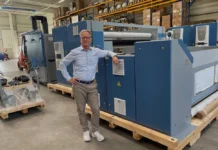
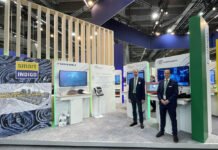


 Muhammad Saqlain, CEO, Maheen Textiles shares his experience with KERAjet and his vision for the future of the innovative pigment digital technology. KERAjet is a revolutionary project that has changed traditional production systems for digital textile prinitng, KERAjet has not ceased to reinvent itself and grow day by day to continue offering the best and most advanced technology. With 20 years of experience and more than 4,000 machines working in more than 44 countries around the world, the company continues to set the evolutionary course of a sector that day by day has been renewing and reinventing itself as a firm commitment to progress and innovation in the areas of Textiles, Ceramics, and others.

With a highly qualified young team with a great capacity for effort, work, and improvement made up of more than 200 people fully involved in the project, KERAjet designs and develops its own advanced technology: mechanical, electronic, and electrical for the development of equipment for Industrial digital decoration, fully controlled equipment, developed and manufactured from its inception to its total completion within the company, achieving a 100% Spanish and 100% own high-tech product.
Maheen Textile Mills installed the first KERAtex GIGA 3400 Pigment Printing machines in Pakistan. To know more about his experience with the KERAtex GIGA 3400, TEXtalks International spoke to Muhammad Saqlain, CEO of Maheen Textile Mills about the beneficial differences this high-end technology has made to their mill.

TEXtalks: Would you like to give a brief introduction about Maheen Textile Mills?
Muhammad Saqlain: The journey of Maheen Textiles started in 2010 and it has been 13 years since we have been leading the way with sustainable home textile manufacturing. We have a great emphasis on sustainability and environmental development. With many reasons to emphasize sustainability, including reduced cost, and protection of the environment, and by doing so, we sustained goodwill from its customers for eco-friendly practices, which follow specific training exclusively designed to train textile industries to maintain a balance between high production and less impact on the environment.
TEXtalks: When did you install the KERAtex GIGA 3400 in Maheen Textile Mills and what was the reason to choose the innovative technology?
Muhammad Saqlain: When we were selecting machinery for our new processing unit in 2021, we decided to purchase technology that would also cater to the future needs of our mill. After meeting with several suppliers, we chose the KERAtex GIGA 3400 which offers digital pigment printing and can have up to 12 inks with 16 heads per color, which means 192 heads and the possibility to include pigmented, reactive, disperse, and acid inks. Our estimated cost calculation also indicated that this technology from KERAjet would be the best option for us as it brought more flexibility into our production and the cost comparison with the flatbed machine was 15% lower, which is a huge difference. Hence, we chose this innovative technology.
TEXtalks: What are the benefits of the KERAtex GIGA 3400 in terms of saving for Maheen Textiles?
Muhammad Saqlain: In comparison to other flatbed machines and through experiments on small quantities, we came to the conclusion that the price was greatly reduced to almost 15%. Water consumption and liquid ratio used were also minimized. With high inflation and rising energy costs, lower costs in our processing unit is our prime objective. The KERAtex GIGA 3400 helped us to achieve that goal.
TEXtalks: Why did you decide to go for a pigment digital printer instead of a flatbed conventional?
Muhammad Saqlain: Along with more costs involved, the conventional flatbed machine took up huge space in the processing area and large amounts of backup were needed for screens and the engravings which would ultimately cause rejections. After a thorough analysis, we decided to go for a pigment digital printer and we are extremely satisfied with it.
TEXtalks: How productive and efficient is KERAtex GIGA 3400 for a printing house and what is its payback period?
Muhammad Saqlain: The KERAtex GIGA 3400 is highly efficient and productive. This technology is a machine that fits our needs and 10 years from now all textile export businesses would use pigmented digital printing in the future.The payback period depends on how much the technology is being utilized but through our calculations, the payback period is estimated to be three to four years.
TEXtalks: What is your experience in terms of versatility and ease of use compared to conventional analog printing?
Muhammad Saqlain: The machine is very easy to use as compared to conventional analog printing. Along with being versatile, it has a very simple and straightforward process that does not involve complex technicalities.
TEXtalks: Which digital inks you are using with KERAtex GIGA 3400 and how are the results?
Muhammad Saqlain: As KERAtex GIGA 3400 is a Spanish machine, we are using inks from Itaca. Their inks have a long shelf life and low price as compared to others in the market. Also, their inks are GOTS-certified and customers don’t have to pay any additional charges other than the purchasing cost.The results are great and so is the quality.
TEXtalks: As Itaca Inks claims, one ink serves every fabric, how is your experience using the same ink for different fabrics?
Muhammad Saqlain: Through multiple experiments, one ink served every fabric and the result was excellent. The machine printed one design on poly cotton, one cotton rich, and one on polyester, the result clearly depicted that one ink served different fabrics indeed.
TEXtalks: How was your experience with the after-sales service from the KERAjet team?
Muhammad Saqlain: We have had a great experience with the KERAjet team and they were extremely supportive and accommodating to all our queries. Their customer services were brilliant and they offered us online technical support along with visits from their team to ensure that all our queries were answered and we gained a complete understanding of the technology. Whenever we faced difficulties, as this is the first machine to be ever installed in Pakistan, they sent the team on first priority to help and guide us. Through online support, our queries were addressed effectively.
TEXtalks: In your opinion, how beneficial could be digital pigment printing, like with KERAtex GIGA, for the Pakistani industry?
Muhammad Saqlain: Most of the Pakistani textile industry uses reactive printing machines, which consume huge water amounts however retailers these days are extremely concerned and prefer reduced water consumption. Digital pigment printing uses lesser water and through my experience, this technology would be a breakthrough in the Pakistani textile industry as it is a much more viable and sustainable option.

